

Earlier this month I left Clarify. I wrote about it on LinkedIn, here.
Since then, I spoke to nearly two dozen different founders who’d gone through the same journey and the verdict was the same: welcome to the club and, man, prepare for some heartache.
It never gets easier saying goodbye to organizations you love.
Leaving Branch back in 2017 was emotional. Selling my first business and later leaving mParticle in 2019 was emotional. Leaving Runway and Ramp were emotional. I’m an emotional guy - I invest deeply in the people around me, and so, saying goodbye is a lot harder. Some people claim to have the ability to separate “business” from the personal.
I call bullshit.
Business is personal. People who pretend it isn’t are fooling themselves. In this case, there were a lot of people I care about I’m sad to be leaving behind.
The silver lining is that the mantra of one of my mentors, Dave Myers, has tended to prevail over the years: companies are often just temporary, relationships, however, are more durable and last a lifetime.
Over 10 years you tend to forget the details about what happened day to day, but you remember the feeling people left with you when you worked together. For some that’s positive, for others, it’s not.
And that’s okay. You don’t have to be liked by everyone to be successful in the world.
Success is also an arbitrary definition that you get to make up for yourself, which is beautiful and freeing.
As I consider the next chapter, I’m wondering what success should look like or feel like. For some, it’s obvious - the big win, a huge payout, the IPO, or the acquisition. But what if you’re part of the 99% of startup operators that doesn’t see one of these things?
It’s still not clear to me, but a few reflections have emerged as I consider what now, and what next…
Time is the most precious resource.
Over the years, I’ve given so much of it up to people and things I didn’t care about, because I thought I had to. Those morning meetings, the weekly group thinks, the 1:1 check-ins. As I’ve talked to founders and business builders, it’s become clear that the only way to build businesses without the overhead is to be in complete control of your destiny. Similarly, I’m at the age and place in my career where I can start to see the horizon - how do I want to spend the next 15 years? I wish I had started considering this question sooner.
Building with AI has never been easier.
Sure there are tools like Replit and Lovable, but for a semi-technical mind, the world is really your oyster. Last weekend I built a fully production grade app and Chrome extension using Cursor on top of Firebase, Resend, Stripe, and open AI. I’ve built web and ruby apps, but never anything this complex. I would always get stuck in the implementation details. “Why is the server rendering this error?” “Let me go look through code stack overflow to figure out how to implement an auth provider properly”. I was never a good enough engineer to implement medium case features - only ever good enough to do the basics. Building with cursor has completely changed this.
Opportunity cost has never been higher.
We are living in the most revolutionary time of the internet’s history. Companies are going from $1-5-10M overnight, 10s to 100s of employees within a year or less. I’ve experienced this twice in my career, once at Branch and again at Ramp. It is intoxicating and one of the best ways to learn and better yourself. If you’re working for a traditional saas company following the triple triple double double formula, it’s like buying a horse in 1903, the same year Ford released his first car.
I’m not lambasting most software companies either. The game has fundamentally changed, and at least for the next 2 years, there is a rare opportunity to ride a wave that the world has never seen before.
Find your people.
One thing I’ve noticed is that over the years you tend to collect relationships across companies that come to constitute your tribe. Your tribe are your people - they are the folks you had the most fun working with, and working with deeply. Things didn’t have to be easy, but the relationship was easy. There was mutual respect born out of an understanding of your capabilities.
Many of the deep relationships I have spawned from my mid 20s grinding away at Branch and then again at Ramp, grinding away on something big. You won’t earn everyone’s respect. Some colleagues will only see you in a fleeting moment. But the ones you do collect will last and sustain you, like a small flame.
This last month, I’ve turned to many of these relationships for support in tough times. It’s the people who know you, love you more than the idea, and know what you’re capable of. Find those folks and don’t be afraid to give them as much of your time as you can.
An aside: That’s also why the idea of burning bridges is absolute bullshit. You can’t burn a bridge if there was never a bridge there in the first place. Bridges are formed through mutual respect. If only half the bridge was ever built, what’s left to burn? Worry less about keeping bridges, and focus on keeping the bridges that matter. You’re never going to make everyone happy.
Service to others.
One regret I have in my career is not leaning in to serving my tribe better. When I left clarify, I had a huge network to call on for emotional and practical advice. Literally dozens of people who admired, respected and loved me. They all supported me through it. I was overwhelmed with joy and gratitude. As I went further and further heads down into startups these last few years, I had forgotten some of these people.
It’s important for me now to keep open a portion of my life committed to serving my tribe. Keeping hours available for casual hangouts with friends building their businesses, offering advice, listening when folks need a shoulder to lean on. I’m most excited for this aspect of what’s next - having the freedom to invest my time as I choose.
What’s next?
Let’s talk about what’s next. There are two things I’m spending my time on over the next few months:
The Growth Stack Mafia & my official return to consulting
Building apps
Consulting After The Growth Practice
First, there’s this newsletter … which you’re reading (yay! thank you)
I’ve called it the growth stack mafia 🥞
Back in 2019 we tried to coin the term growth stack around the b2c martech stack we would deploy for different companies. It clicked in some ways. But today, a growth stack is so much more. It involves people, processes, tools, frameworks and strategy.
And it’s not just limited to martech and revtech. It spans finance and operations, too. Your growth stack is the fundamental atomic unit that helps your business tick.
Why mafia? Well it sounded cool, and because I think the people who are great at martech and revtech are few, exceptional and run together. I want to create a community around these unspoken heroes inside organizations, doing the dirty work to keep their revenue teams going.
So that’s the first goal of this newsletter - talk about the tools, technology, people and strategy involved in building a foundation to grow your business.
There’s also another simple goal: Document and share the learnings I have from consulting in the field with epic companies.
Most people don’t know this but back in 2018 I built a $2M consulting practice around growth engineering and martech. I sold the business as “The Growth Practice” to mParticle.
I’m immensely grateful for that experience, but I often wonder about what could have been. I was convinced at the time that it would be too hard to build a repeatable agency model around the work I was doing. Now, four startups worth of experience later, I think I was wrong.
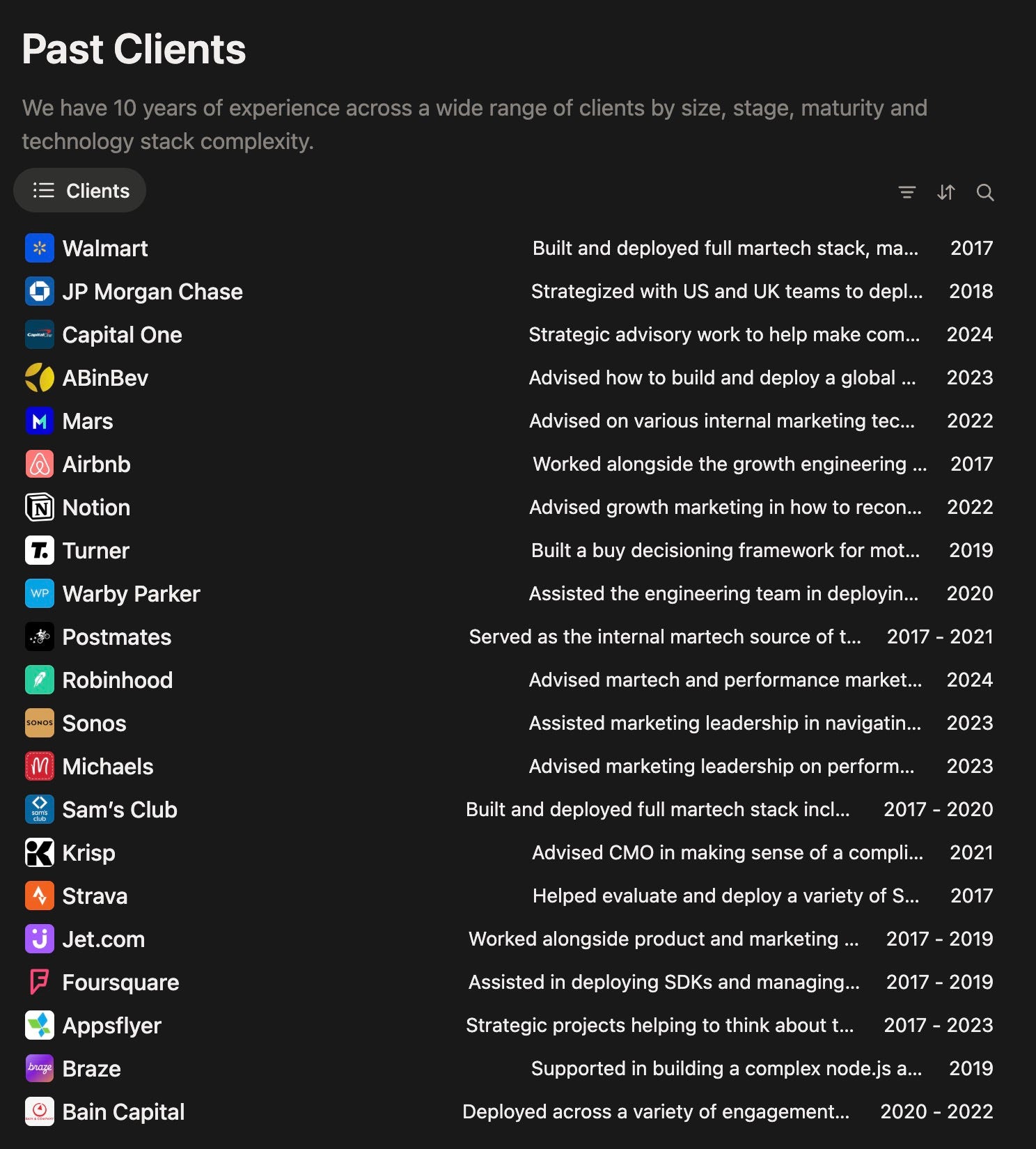
So, to that end, I’m jumping back into consulting on a part time basis, and one of the outcomes of that will be writing here.
Another outcome will be turning what I learn into Maven and Reforge courses. I’ll be continuing to offer my Martech class through reforge, and I’ll be running new content through Maven.
There’s also another reason I want to return to writing on a regular basis. I find myself getting dumber from using ChatGPT to write everything for me.
Writing is thinking. Thinking is power.
As I shift out of anxiety fueled founder builder mode and into strategic business building mode, I want to devote more of my time to thinking. And that means writing more about what I see, hear, learn and do.
For example, last week I kicked off an engagement with Capital One. What did I learn from 2 hours deep diving with one of the most admirable companies on the planet?
You’ll find out next week. 😎
Just Building Again
I read a business book in my 20s called The Neatest Little Guide to Stock Market Investing. In it, one of the central premises of investing is to invest in things around you that are obvious. A great example is Costco. If you’ve ever gone to Costco, it’s hard to ignore what a great business opportunity it is. You don’t need to listen to the Acquired podcast on it - it’s just obvious. It’s a feeling you get from understanding the problem, the pain and the solution.
One of the arguments that the book makes is to look for these types of bets in the stock market. Buy the things that are around you, that are part of your life, that are obvious good bets because you yourself use and love the product or value being created.
The same applies to business opportunities. Create a list of the obvious that surround you. Observe, document your pains, and eventually, solve your own problems.
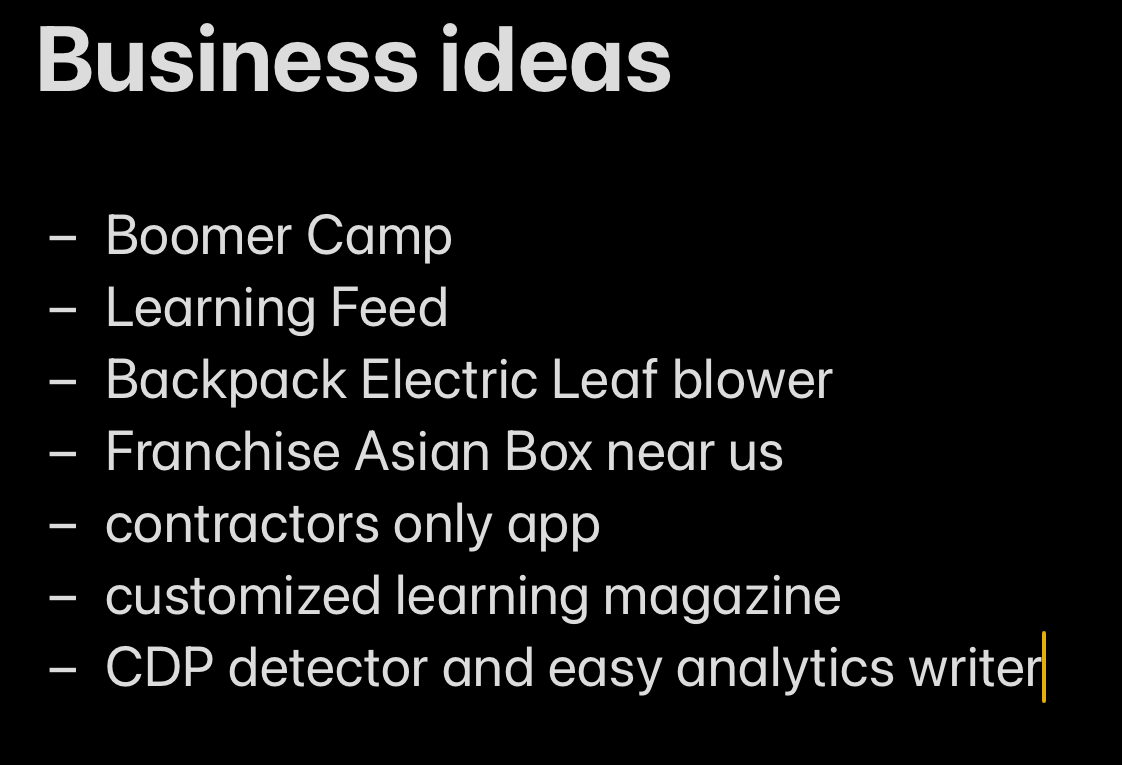
I would do this in the past with small little widgets or pieces of code. But AI has fundamentally changed how I’m able to solve problems with prototypes and fully functioning apps.
Last weekend for example, I built an entire app in 48 hours around a problem that I faced myself. I built the backend on firebase, hooked it up with Resend to send automated emails, enabled Stripe, built a chrome extension (and submitted to the chrome store), and so much more. I did this all with a basic understanding of programming and cursor.
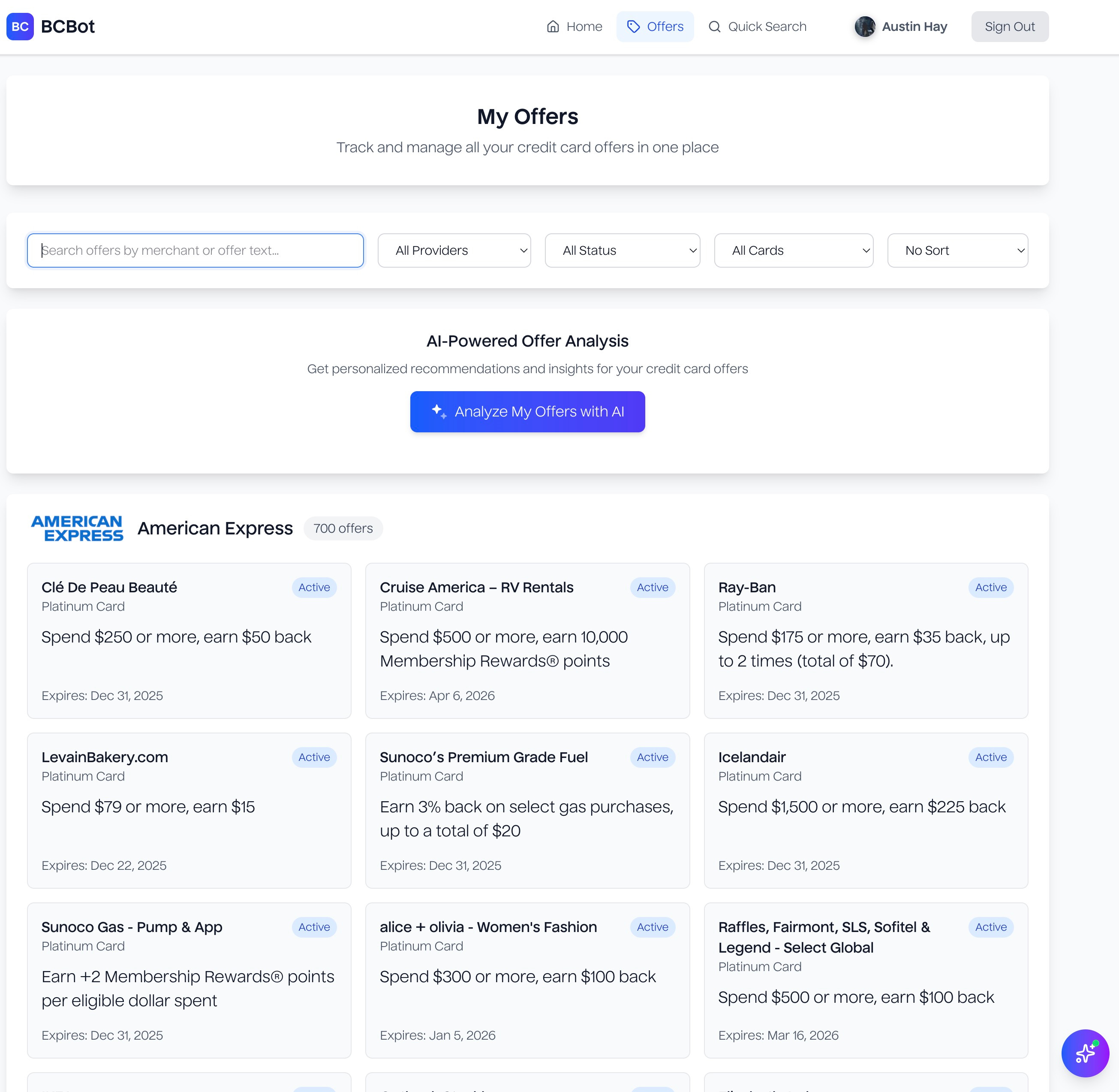
If you want to check out what I built, head to bcbot.co and ask me about it. I currently have nearly 100 people testing it already.
None of this is revolutionary, but the speed from problem to solution is wild.
This is how I plan to spend a portion of my time - observing and building.
I’m keeping a list of problems that me and friends face, and I’m building small solutions to those problems. In some cases, it might make sense to monetize it. In other cases, those solutions might be deployed as businesses in my consulting work, or sold to companies who would rather pay for a service solution than saas.
The point though is to actively be in builder mode flexing the muscles and knowledge on how to ship something quickly. That way when the right opportunity or idea does strike, you have the infrastructure in place to take advantage of it.
I’ve also been inspired by two ideas lately: the concept of a venture of portfolio businesses (Andrew Wilkinson on Lenny’s), and by what Sam Altman has described as the $1B business that is run by a single individual.
We might not be there yet, but I think we are at the point where many $1M - $100M businesses can exist with a single or very few individuals. In order to be one of those people, you have to be willing to roll up your sleeves and just build.
If you’ve made it this far, you’re either a masochist, an LLM or a super fan.
Drop me a line at austin@hbe.io. I’d love to hear from you.
Fuggetaboudit! Long live the Growth Stack Mafia! Also, thank you for sharing all these ideas and learnings, very helpful (and inspiring!).
can't wait to see what you build!