

In the last few weeks, I’ve had nearly 100 calls with founders, marketers, rev operators, and more. A question that has come up frequently is this:
“So what have you learned about marketing in 2025 compared to the past?”
When I sat down last week with a Series A Head of Marketing, I decided to put pen to paper around the advice I’ve given to those in similar positions (<$10m ARR).
Here are my notes from the last few weeks of reflection and the call with this marketing leader.
Team & Resources
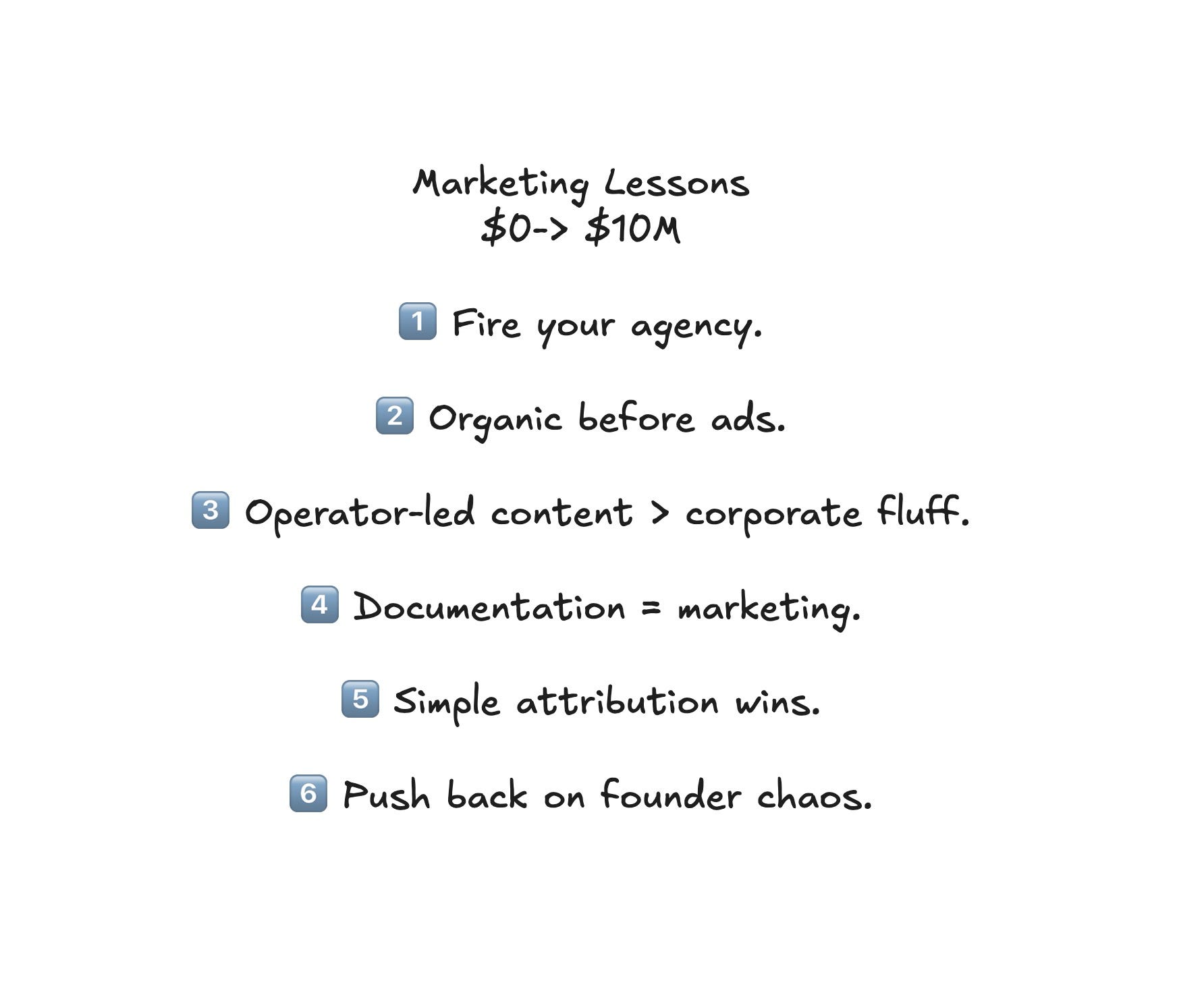
First, too many early-stage companies are relying too heavily on agencies to fuel their growth. Fire your agency, hire in-house marketers. Don’t get me wrong, agencies can help provide depth to your marketing efforts if you’re constrained on certain strengths or to help in a pinch when you can’t scale up the team. But more often, agencies are band-aids. People think that by hiring an agency, they will suddenly get to their goals without doing the hard work. The reality is that agencies often come hand in hand with avoiding the hard work of being strategic and learning about your audience and message.
So, my 2 cents: Use that $40K/month to hire 2–3 full-time marketers who can own strategy and execution.
Channel Prioritization
Next, build organic flywheels before spending on ads. If you rely on paid acquisition from day one, you’re just buying your way to value. Create a product and marketing experience that people naturally talk about.
This is a contentious claim, and I know many people will disagree, arguing that ads can help you learn about your customers.
And this is true, but for many companies, they don’t actually learn at all. They pursue easy, obvious ad placements that don’t actually contribute value. They aren’t creative. They spend poorly on things like brand keywords.
Instead, I think at the earliest stages of company building, you should focus on LinkedIn, community, email, and word of mouth referrals (plus the technology to power this!). These channels build and then sustain a momentum. Save Google Ads for later when you have more resources. Most people end up blowing $100k-$1M because they aren’t ready.
If you’re going to spend ad dollars, what I’m seeing currently work well is when folks boost high-performing LinkedIn content ($20–30K) before running Google Ads. Amplify what’s already working organically.
LinkedIn Strategy
People follow people, not companies. Your founders need to post daily. Hire a content agency to interview them weekly and turn those conversations into posts, videos, and podcasts. I know a great one if you're interested. Just DM me.
Post authentic stories, not corporate fluff. Share personal experiences, lessons learned, and critical opinions. Skip the AI-generated thought leadership—it’s obvious and nobody cares.
Sustain boosts on your best content for months. LinkedIn recycles popular posts through feeds over time. A post from November can still generate impressions in January if you keep it boosted.
Measurement & Attribution
Add a required “How did you hear about us?” field to your demo form. Direct attribution is on life support and often not very meaningful to sub $10M ARR companies. This simple question gives you the best signal for what’s actually working. Don’t let anyone in product or design tell you it adds too much friction—if someone bounces over one form field, they weren’t qualified to begin with.
Use AI to categorize freeform responses into groups. You’ll get dimensional data on where leads originate without the need for complex attribution tools.
And of course, you can add the basic direct attribution stuff - throw in PostHog or another analytics tracker. You’ll get basic information on known channels. But I’ve found this largely just confirms what you already know. An open-ended HYDYHAU has the potential to teach you something you don’t know about what’s working or not.
Content is still king, it’s just different
Many teams wait until far too late to develop content. They overinvest in things like a blog or newsletter without having a clear strategy about who they are targeting and what value they are providing to them.
Or they pick the wrong audience too soon!
There are a few things you can think about to nail content as a channel:
Focus your audience
Deliver real value
Treat every surface area as an opportunity to persuade
First, in focusing your audience, what I mean is, be incredibly specific about who you are talking to. Don’t split your audience. Don’t focus on your audience in the future. Don’t go on side quests. Pick the one person you are selling to today and focus exclusively on a message to them.
Next, write stuff that is actually useful. Google and other search portals are getting smart at detecting AI fluff. About a year or two ago, this wasn’t the case, and you could juice your SEO generated traffic with a high volume approach. There are merits still to high volume, but they need to be specific, and they still need to deliver value. If you are going to try this approach, you can use long tail search query results to come up with bulk content, but you risk this being completely ignored by search engine results and LLMs. You have to think about how whatever you create in bulk can either A) still be very useful and unique, or B) how you can use this content-en-mass approach to support whatever motion you’re running. For example, a very successful Series A company I spoke with is using Air ops and Profound to come up with thousands of long tail search terms and queries that they know will feed LLMs. The game is not necessarily to create 100,000 pieces of content. Instead, they are mixing these across Reddit, LinkedIn, and yes, some short-form pieces on their company website. All of this content is created or shaped by AI, but ultimately proofed, reviewed, and edited by real humans.
For most small teams that have limited time and resources, coming up with an authentic, creative, and useful piece of collateral that would actually help the people they are serving is the right move.
Likewise, sometimes the best ideas for what to write or create come from obvious places. This is why you should treat all your surface areas like an opportunity to provide value. Treat documentation as a first-class marketing channel, for example. Help content solves customer problems and captures search traffic. Do this from day one.
Last, skip the corporate blog unless it’s for hiring, market signaling, investors, or somebody else who is important to you. I’ve found that nobody really reads company blogs. Put high-quality thought leadership under founder names on LinkedIn, a Substack, or another place where people can follow other people.
Strategic Discipline
Another obvious piece of advice, but create a clear strategy with 2–3 core bets. You can’t do everything. Outline which channels will give you the most impact and commit to them.
Optimize existing channels to their maximum potential before adding new ones. Once your flywheel is spinning on 2–3 channels, then experiment with the next. If you are going to experiment, think about how many experiments you run in a single channel vs across many channels. Also consider that running an experiment doesn’t eliminate the channel permanently - it’s a time and place approach. You may have missed the few variables that would have driven success. This is why experimentation on many channels early on is so hard. It’s like trying to find a needle in a haystack, and you may write off something good as a false negative.
Far too many teams try to do too much. It’s often because of unrealistic expectations from founders who have never done the job before. Push back on the founder's whims to do everything at once. Your job is to provide experienced guidance on what’s realistic, not bend to every new idea. Be clear about what it takes to do more: more people, more time, or fewer channels.
Execution Reality
Marketing takes time. Product takes time. Everything takes time. Founders consistently underestimate the effort required by channels and overestimate what small teams can deliver.
Founders consistently put too much pressure on themselves and their marketers to produce wins quickly. Patience. Patience.
With one marketer, you can realistically do two channels really well. Plan accordingly and set expectations with leadership from day one.
… and last for all the people that need to hear it: The best way to win in marketing is first and foremost to create a great product that people love to use, helps them solve a problem, and brings them joy. Do this first, then focus on marketing.
Great post Austin! I agree with 93% of this : )