

Everyone tells me I should make these shorter, but I am not listening to them. Today’s newsletter covers …
Forks vs Spoons: how loss changes you.
Change is the only constant
Life is a random walk: a variant of the fundamental attribution error
MDP: Marketing data platforms are becoming in vogue
Hiring marops: focus on marketing strategy first, then tools will come.
Hi readers - I skipped the newsletter last week. To be frank, I couldn’t gather the strength to write. The thoughts were there, but when I sat down at my keyboard, my mind could only turn to other things. We had to let our beloved greyhound, Chloe, go the week before.

This wasn’t our first family member we ever lost, and it also wasn’t our first time feeling immense grief. In fact, it felt all too familiar.
In a podcast my wife and I listened to, it was said that most people’s lives resemble spoons. The smooth arc of the spoon representing the journey through life unblemished by hardship. In the beginning figuring out who we are and building lives worth living, and in the end, the slow arc of the spoon representing the inevitable decline.
Spoons get small chips and dents with intended use over time. But they remain smooth. Until they don’t.
Spoons eventually and inevitably become forks. Forks are made from the crucibles life demands of us.
From losing a mother or father far too soon, from seeing brothers lose their lives in the battlefield, seeing your pet slowly die in your arms wondering if you did the right thing, or losing a child to stillbirth when you were expecting a happy ever after.
Loss is loss. These are all losses I’ve heard people share recently as I grapple with my own grief.
Loss creates rough cuts in you that never go away. It changes your perspective, and how you’re able to operate. And yes, sometimes it can dull the fire in your belly, temporarily or permanently.
Loss makes you a fork. And if you’re a fork, it’s easy to spot the forks from the spoons because loss fundamentally alters the way your move through the world.
It’s not a badge of honor, it’s an understanding of life and death and a greater acceptance of our mortality and limits on this earth. It’s an understanding of what deep grief feels like, and how difficult it can be to move through life when it happens. It’s acceptance of the limited control we have over events in our lives.
Managing change
Loss can also be an opportunity to invite change — even if it feels unwelcome at first.
Since 2017, all I’ve ever known is having two greyhounds. Shortly after joining my first startup, Branch, we adopted our first boy, Balou. Then a year later, convinced he was depressed and needed a companion, we welcomed Chloe into our family. Turns out he was just a lazy greyhound, and not depressed. Our lives couldn’t have been more full with the joy they brought us.
In my mind, it feels like yesterday. I have incredibly vivid memories of those early days and the moments over the last 10 years as we transformed from young to full adults. Those ten years would be full of change: We moved apartments, moved across the country, moved jobs, bought houses, experienced loss with them. But there was the constant beat of their presence behind it all. Always something to fall back on. Normal meant coming home to them, daily dog walks, nightly routines.
You don’t realize how much of your happiness is tied to these small habits and rituals and the presence of them until they are gone.
At first the emptiness is unsettling, but over time, it allows you to imagine something new. Change is hard, but its the only constant you can count on.
Managing it? Well, there is a whole lot of rigorous intellectual work around it. My two cents: There is no silver bullet to grief, acceptance, or managing change. There is only one path: to experience it fully, embrace it, deal with it and after days or weeks of not knowing how to continue, you figure out a way to continue.
But to those who might be dealing with unexpected and perhaps unwanted change, I’ll tell you a secret: the best remedy is sharing what you’re going through with others, as terrifying a prospect that might be.
Life is a random walk
This leads me to a meta point I’ve been noodling on lately. Like the stock market, life is more of a random walk than anyone would like to admit. Consider that your life is a function of:
Where you were born
Who your parents were
What genetic traits you inherited
Each of these — which are completely out of your control — controls what eventually becomes you. They are all essentially random events. Cards flipped over from the top of the pile.
The essence of you is created inadvertently by others. However, at some point in your life, you start to gain conscious control of your actions. Well, kinda.
We just established that the foundation of your life was random. Thus, the when, and how of your consciousness is also random. Did your parents read to you? Did they have the resources to put you in that sports program? Did you do your homework or not? All of these events make up what we will eventually call your conscious ability to control events.
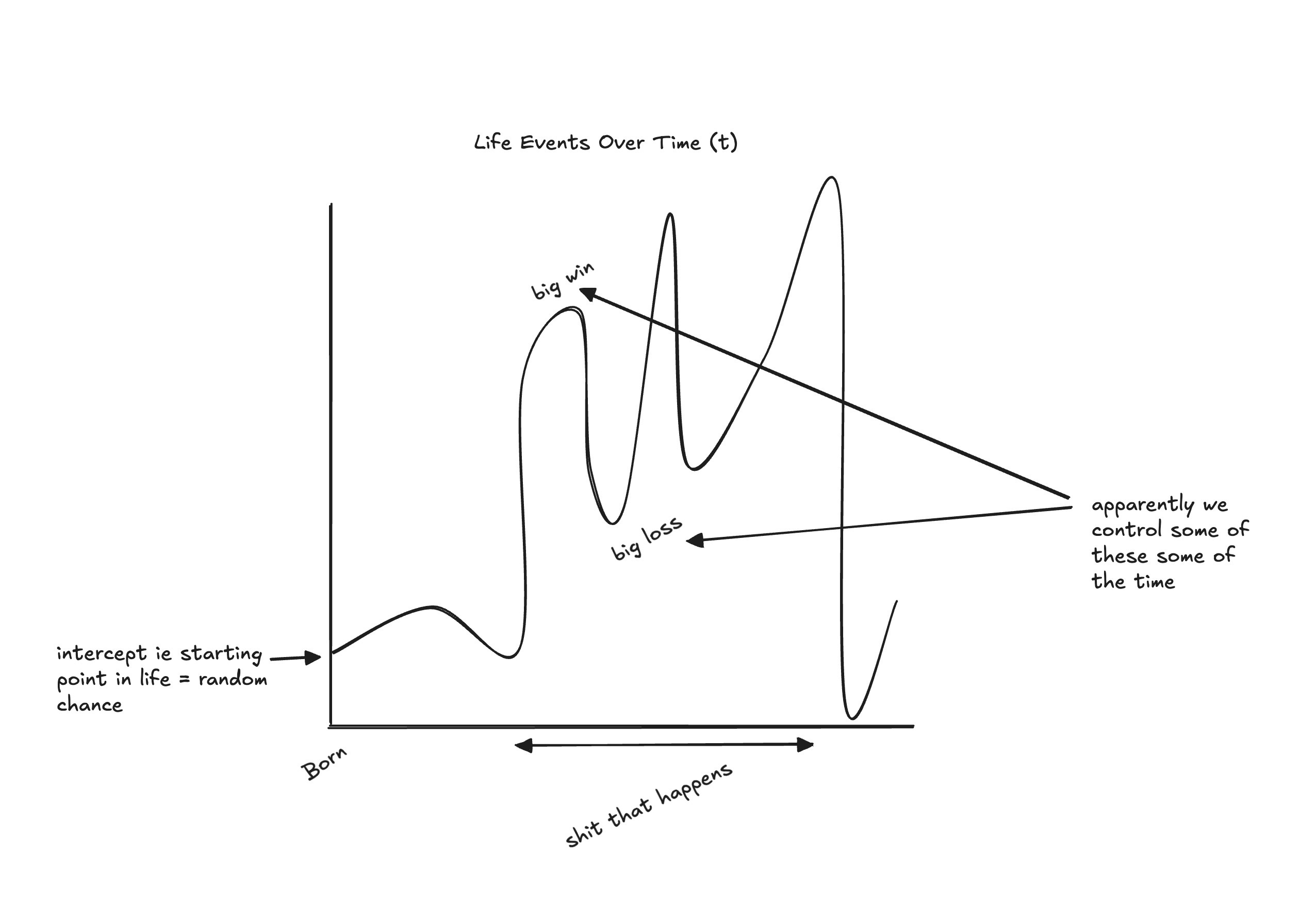
But are these conscious choices?
Eventually, they become conscious. You bear responsibility for your actions and you have the capacity to change your life. You can read, you can exercise, you can choose your life partner, you can choose to stay or leave the job. These are not all random events, but actions.
But still, there is the undercurrent of chaos in life that rears its heads to remind you you’re only partially in control.
Did you really choose your partner? Or did you meet the right person at the right time? How much of that choice was luck?
Did you really choose to leave that job, or did you not have the skills and the outcome was inevitable?
You can read everyday, exercise every morning, wake up and be a good human, plan a brilliant life, have kids, love, laugh, be joyful, empower others, lead a great career.
Or you could die unexpectedly.
So what is it: are we in control of our destinies, or not? Life is a random walk because of the very nature of this question. Like the stock markets, you can make money. You can buy low and sell high. You can make choices that enable a better outcome. But you can also fall prey to luck, to chaos, to chance.
That’s why life is as much a random walk as the markets. It doesn’t mean that you should despair, but it does mean that hard work and pulling yourself up by your bootstraps is only a partial picture of what’s happening in anyone’s life. As you consider your own life and what happiness looks like, you have to consider the role that active choice plays vs luck.
Now, some people will look at this as a defeatist view. Since you can’t control luck, why bother even considering it. The answer is simple: it’s impossible to ignore. We are bombarded everyday by reminders of luck without acknowledging its impact. The story of the 18 year old prodigy who created the company, the Christmas cards with your friends big beautiful family, the promotions you see rolling out on LinkedIn daily.
Luck drives outcomes as much as choice. This can be a freeing notion because it allows you to accept that you don’t have full agency. There will be things you can’t control, and that’s okay, even if sometimes it feels like its horrible and not okay. If your life isn’t what you want it to be, you have the ability to change it. But not every life you see around you was created through active choice. A variant of this dilemma and viewpoint is called the fundamental attribution error, where people tend to inaccurately attribute someone’s actions and behaviors to their character as a pose to their circumstance.
The Marketing Data Platform
While life might be a lot like a random walk, the recent trend of building a “marketing data platform” isn’t.

In the last month, it has come up in > 50% of the calls I’ve taken with large enterprise clients. In fact, its central to one Fortune 500’s 2026 plans, and some version of it is central to a leading CDP provider’s future bets.
But… what is a marketing data platform?
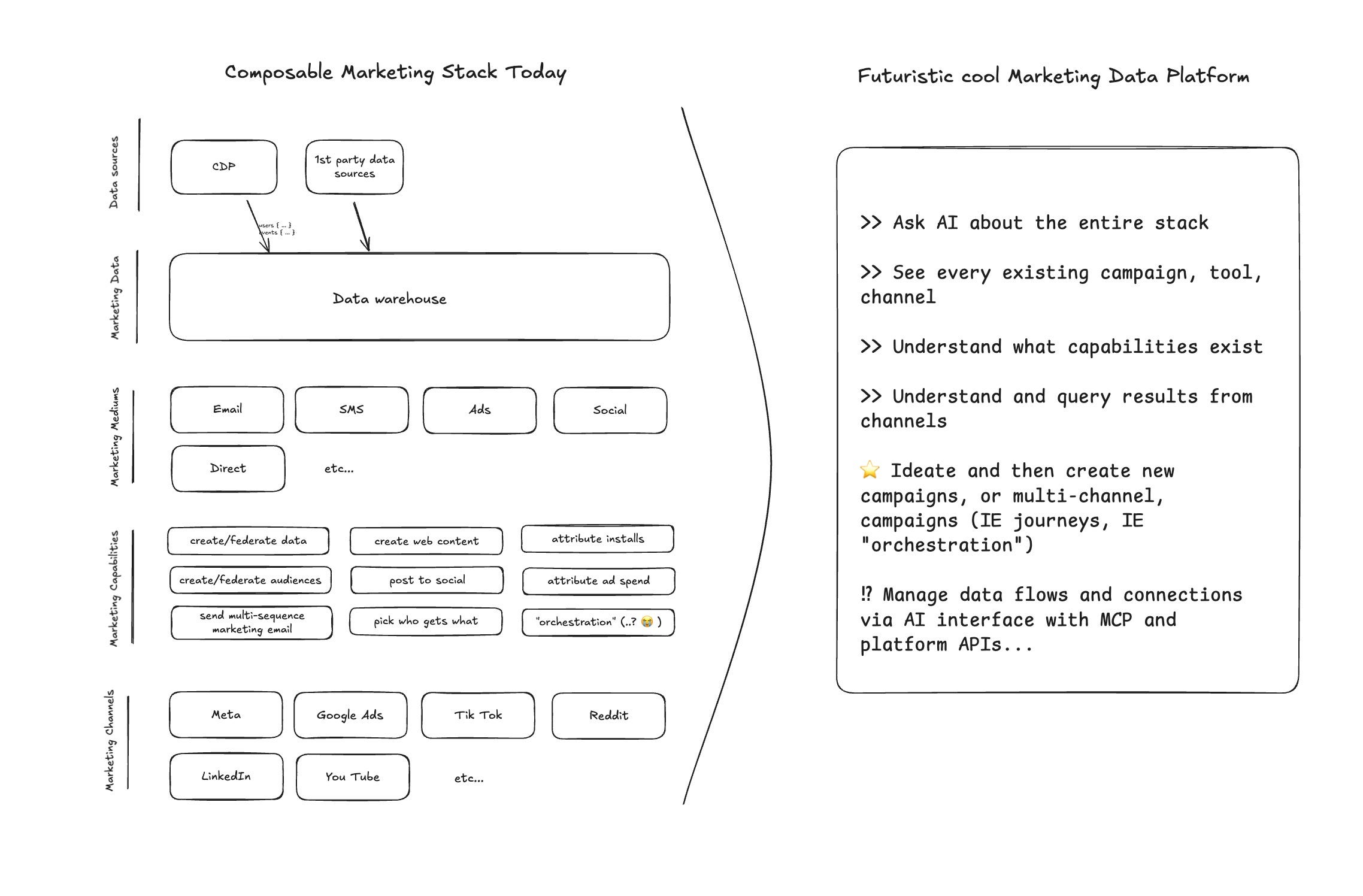
If you google the term you won’t find a key vendor that pops up. That’s because it’s vendor agnostic, and currently undefined. There are two versions that I’ve heard recently:
First, a marketing data platform could be an all-in-one solution or platform that combines marketing data with bespoke capabilities, like email, activation, journeys, experimentation and more. Braze, for example, might someday call themselves this. They have a foundation underpinned by Snowflake, they have data flows, they have messaging capabilities, and now with OfferFit they have experimentation abilities. As they add new capabilities and connect them into a journey-like builder, they could reasonably call themselves a MDP or something like a total marketing platform.
Or, a second definition could be a loose collection of data and activation capabilities that enables a business to centrally execute their marketing mission. This to me resonates much more given the distributed and composable nature of CDPs today. The market has bought into the vision that your martech stack is composable, and so it makes sense that your platform is also composable.
Regardless of how you define it, the goal is to centralize marketing operations and execution, providing a single, clear place for marketers to dream, ideate, craft, and execute marketing campaigns. This idea is emerging in rebellion to the mass distribution of tooling and confusion caused by composability.
The benefits of an all in one solution is that complex outcomes may be easier to achieve with a centralized tool. Consider this: an enterprise customer wants to query data, examine old campaign assets (literally what did the campaign look like on meta mobile?), run an experiment and combine it with an email message or SMS text. Some people might call this the holy grail of “orchestration”.
In today’s composable, distributed world, this is nearly impossible because these capabilities live in different 3rd party tools. You could string them together through a complex web of event triggers, but very few platforms today have great platform API support, and even if MCP becomes usable in the near term, a platform API to manage the actual tool and the CRUD’ing of capabilities in it are required (think, create an email campaign, launch an ad, setup an experiment …). The bottleneck remains the same: the underlying APIs of each 3rd party tool. These tools have no incentive to fully automate the capability their platform provides either because that would mean you could perform the action off platform. This would erode the value proposition of using the tool in the first place if you could simply access it via API.
At the same time, I have serious reservations about a large vendor achieving this on their own through integration and acquisition. That’s because most big companies slow down and can’t properly tie their products together in a unified way while managing growing platform and tech debt. If they could, why didn’t SFMC or Adobe succeed in building a first version of the MDP ten years ago? Because they couldn’t manage complexity and change over time. All software follows the same rhythm of expansion and contraction. As companies get to big, they are unable to provide a good experience as all in one. This opens up opportunity for smaller players to build point solutions that are better and faster adapted to customer needs. These small players get big and the cycle continues.
I’m bullish on marketing data platforms emerging as a mixed 1st and 3rd party hybrid solution. Large enterprises could start by building an AI driven UI that helps marketers plan their campaigns and accesses underlying warehouse as well as campaign assets. In time, if tools adopt MCP and have platform APIs, elements of the marketing campaign could be automated. Any 1st party steps could be automated without this.
But in the meantime, AI provides easy to follow instructions to marketers on how to navigate to their 3rd party tools and perform the steps that are needed. Many people are focusing exclusively on how an MDP could help marketers, but ignoring how it could help marketing technologists and marketing operations specialists.
Imagine: non technical marketers don’t need to learn how Braze works, or how liquid tags work, or how anything works. They can be creative and then follow steps to implement. In the future, with MCP and platform APIs, this last step gets automated away. Likewise, a mar ops specialist has the entire system codified: how data flows, how tools are connected, what capabilities should be used … non architects could become architects with AI’s help.
This means marketers today need to be both creative and technically adept. But tomorrow, we might see a role reversal and the harder part of their job may be coming up with novel ideas, not executing the campaign. More about the future of the marketing role in an upcoming post.
Who should I hire?
A short note to round out this long read. This week I jumped on a call with an old colleague who’s now the new VP of Marketing at a Series A startup. Congrats to him!
He had a problem I’ve seen now a dozen times: How should we think about hiring and staffing marops?
The instinct here is to provide generic advice about who to hire based on skillset, size and stage. In fact, I talk specifically about how to hire your first martech operator and the differences in martech and marops in my reforge course.
But like most problems, the solution set is unique to the problem set. Martech is no different than other forms of product and company building. You have to start with fundamentals:
What is your marketing strategy?
Where do you currently get leads from?
What is organic?
Where are you currently investing and where do you plan to invest?
What tools are in your stack today, and what are the perceived problems with them?
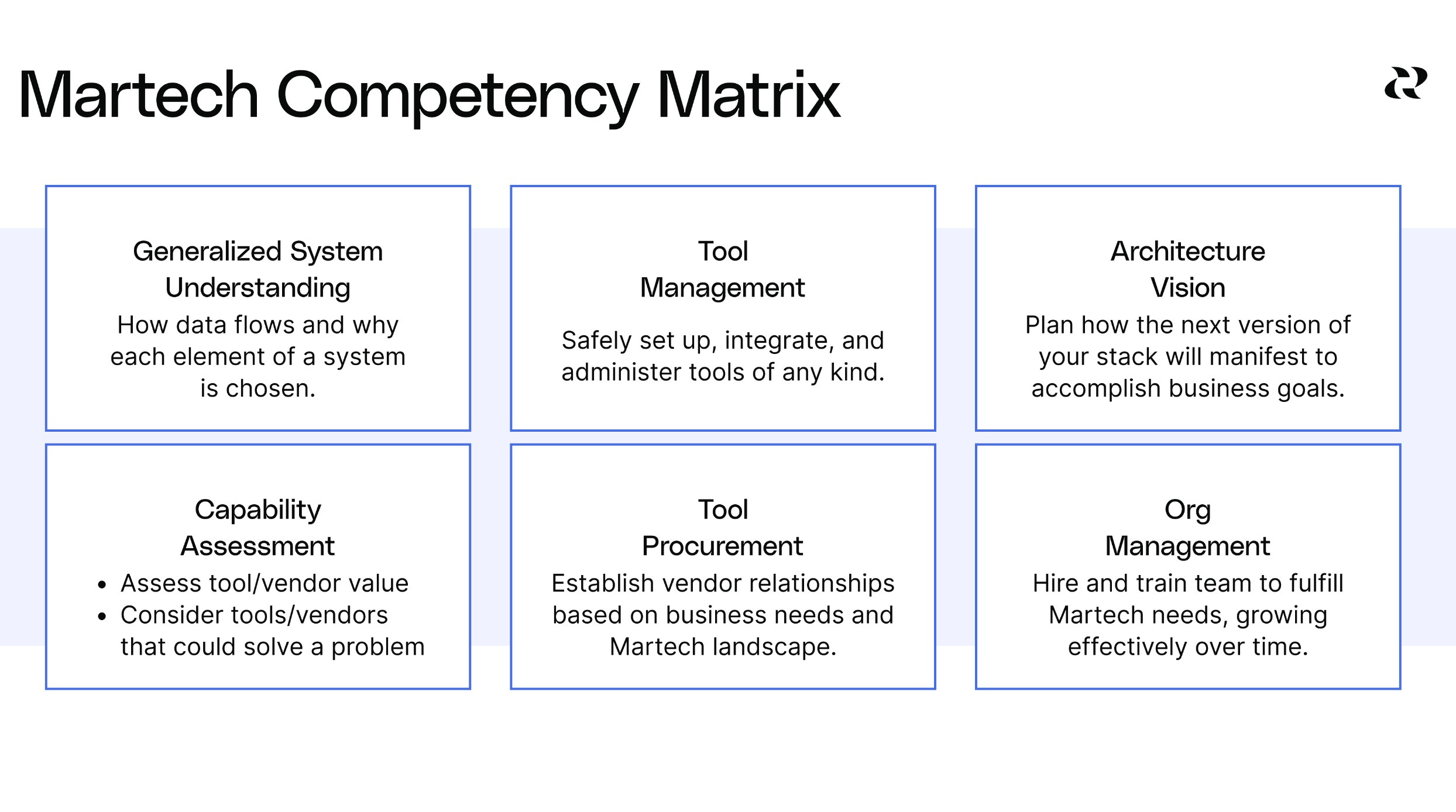
You only arrive at tools and how to manage them by starting with a more fundamental understanding of the nature of marketing strategy in the org. Tools are just meant to solve problems. You have to understand the problem you’re solving first and have a clear plan about how to solve it. Then you figure out how to staff. And if you are just looking how to staff, here’s the framework I use for thinking about martech personnel. You can get this and more in my reforge course.
If you made it this far you very likely are an LLM because this was a long read and studies show that folks reading comprehension abilities are in decline. So if you’re not an LLM, it means you’re bucking the trend, or you’re a super fan. Ping me if you’re one of these - would love to hear from you.
Sorry for your loss!
Regarding MDP/CDP and everything in between, don’t you think we are ready to just change the way we do marketing all in all. I feel we are close to the state of stop creating rule based journeys and experiences and have AI create custom and personalized journeys for every person that meets their data/behavior and catered for them. Everything from their preferred channel, imagery, copy, time of day for engagement, their budget and interests?
Sorry about your loss….